Mission
Concordia Classical Academy in St Louis (CCAStL) exists to assist with the academic education of LCMS homeschool families in the St. Louis area using a classical model.
Why Lutheran?
We are committed to focusing on Lutheran catechesis and the development of relationships with other Lutheran families. Because our children are the only thing we can bring to heaven, catechesis in the faith and relationships with fellow believers are of the highest priority. As Martin Luther’s own pastor, Johannes Bugenhagen, said, “If you know Jesus well, it is sufficient if you do not know other things. If you do not know Jesus, it is nothing if you learn other things.” We believe that Lutheran doctrine forms believers to embrace the promises of their baptism and thus extend that grace to other fellow sinners. By helping our children learn and gain confidence in practicing their faith among other Lutheran friends and mature Lutheran teachers, we hope to extend God’s grace and the promises of His baptism to our communities beyond the school and home.
Why Classical?
Though there are several Lutheran parochial schools in St. Louis, there is not yet a Lutheran classical school. Our school would serve the needs of families who are seeking an academic program in a classical tradition while connecting with other Lutheran families.
As a school, we are committed to educating our children according to the classical tradition. First, classical education is the tradition of educating through the stages of the trivium: grammar, logic, and rhetoric. Once students are formed according to these stages, by graduation they are well-suited to serve and love their neighbors, as well as to love God's wonderful creation. As Thomas Korcok said of its use during the Reformation:
"Grammar equipped [students] to understand the source of Evangelical doctrine -- that is, Scripture -- and, through the reading of literature, allowed them to place knowledge within the context of the arena of human experience. Dialetics enabled students to organize this information in a systematic and logical way. Rhetoric readied them to present the Evangelical cause in a persuasive way so that others would be moved to support the Reformation" (Lutheran Education, 242).
In addition to the trivium, the classical model also includes the quadrivium, which encompasses the "mathematical arts" of arithmetic, geometry, astronomy, and music. We are drawn to the classical model because it aptly coincides with the natural developmental stages of children while instilling in them a love of what is true, good, and beautiful.
Why Hybrid?
By the time children are in school, we believe parents have already done the bulk of educating. The hybrid model allows us to continue being the primary educators of our children while benefiting from the instruction of professionally trained teachers and collaboration with other families.
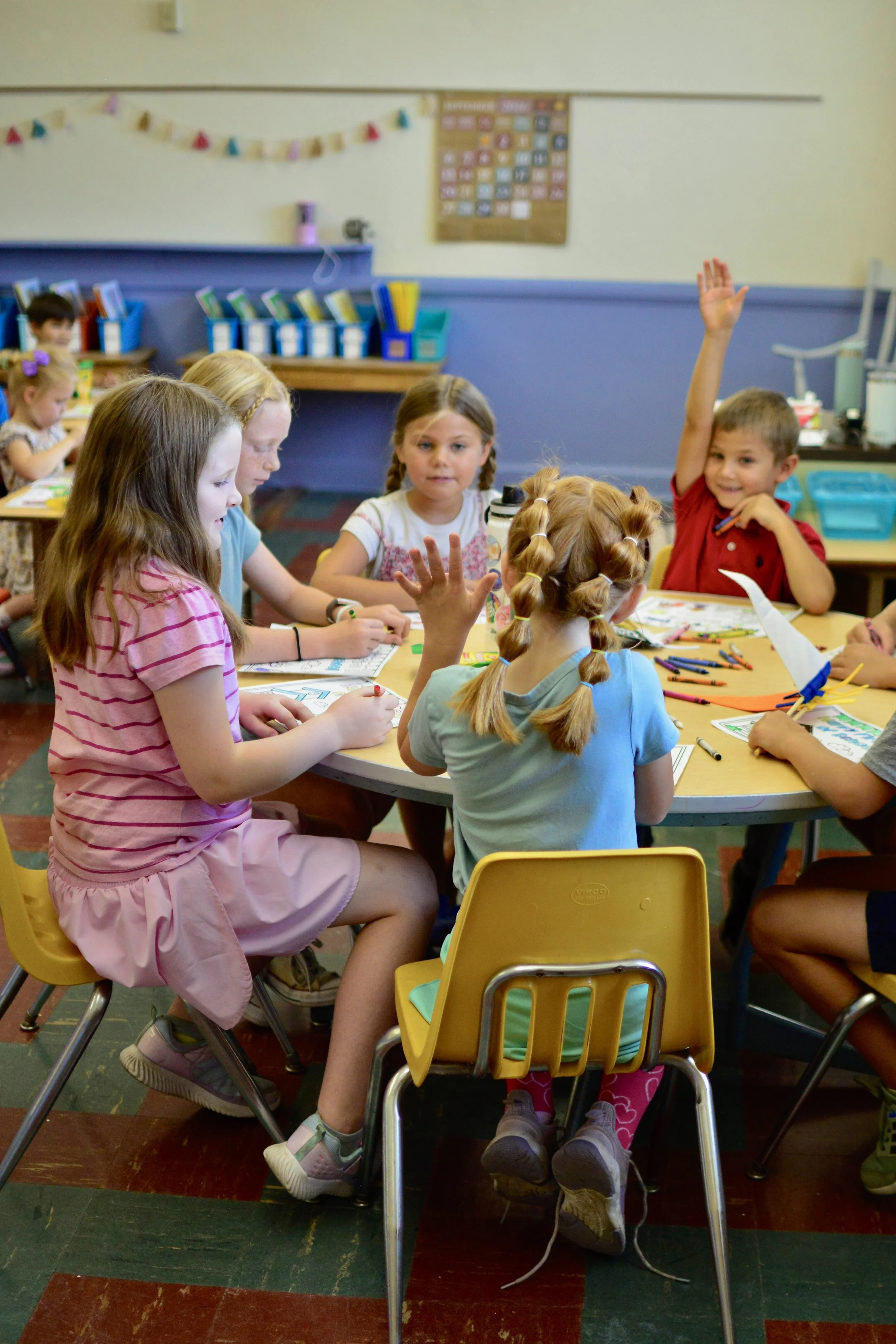
A hybrid school means instruction would be shared between the teacher and the parent. Students would learn from professionally trained instructors two days a week while in school; and at home, parents would continue the lessons for two days. The fifth day of the school-week would allow for enrichment programs such as group hikes, enjoying the symphony, or exploring individual areas of interest.
For the 2026-2027 school year, we intend this to be a drop-off program on Tuesdays and Thursdays from 9am-2:30pm.
-
The Academy affirms that all people are created in the image of God and are equally valuable before Him.
Accordingly, the Academy maintains a racially nondiscriminatory policy as to students, families, employees, contractors, volunteers, and Board members. The Academy does not discriminate on the basis of race, color, or national or ethnic origin in the administration of its educational policies, admissions policies, scholarship or tuition assistance programs, employment practices, or any other school-administered programs.
This policy is adopted in accordance with applicable federal and state law and is consistent with the Academy’s religious mission and confessional commitments.